


Taste the authentic flavors of Thailand with Eat Walk Talk Tour.
Savory Thai Food: From Street-Tested Classics to Top Famous Menus 🍲🌶️
Thai cuisine is universally acclaimed as one of the world's most sophisticated culinary traditions. From bustling night markets bathed in neon light to venerable Michelin-starred royal dining rooms, Thailand's gastronomic identity is distinguished by its daring, uncompromising flavor architecture. While global diners frequently associate Thai food with either overwhelming chili heat or sweet street noodles, true Thai gastronomy is rooted in a philosophical concept of culinary equilibrium: the Five Flavors Harmony (รสชาติทั้ง 5), where spicy, sour, sweet, salty, and bitter/umami components interact in dynamic synergy on the palate.
Whether you are an adventurous backpacker navigating the sizzling woks of Bangkok's historic alleys or a discerning foodie seeking deep culinary literacy, understanding Thai savory cuisine requires exploring both internationally celebrated masterpieces (like Tom Yum Goong and Massaman Curry) and the humble, street-tested staples that fuel millions of everyday Thai citizens from dawn until late midnight. To dive into Bangkok's ultimate food street, make sure to read our companion guide on Recommended Bangkok Chinatown Food and explore authentic northern dishes in our Delicious Chiang Mai Food Guide.
🥢 Thai Flavor Master Rule: A true authentic Thai savory dish never relies on a single dominant sensation. Instead, every bite presents a multidimensional journey: fiery bird's eye chilies (Prik Kee Noo) are tempered by the citrus punch of fresh lime juice (Manao), the savory depth of aged fish sauce (Nam Pla), aromatic herbal oils from crushed galangal and lemongrass, and a whisper of coconut palm sugar (Nam Tan Peep).
The Global Superstars: World-Famous Thai Masterpieces
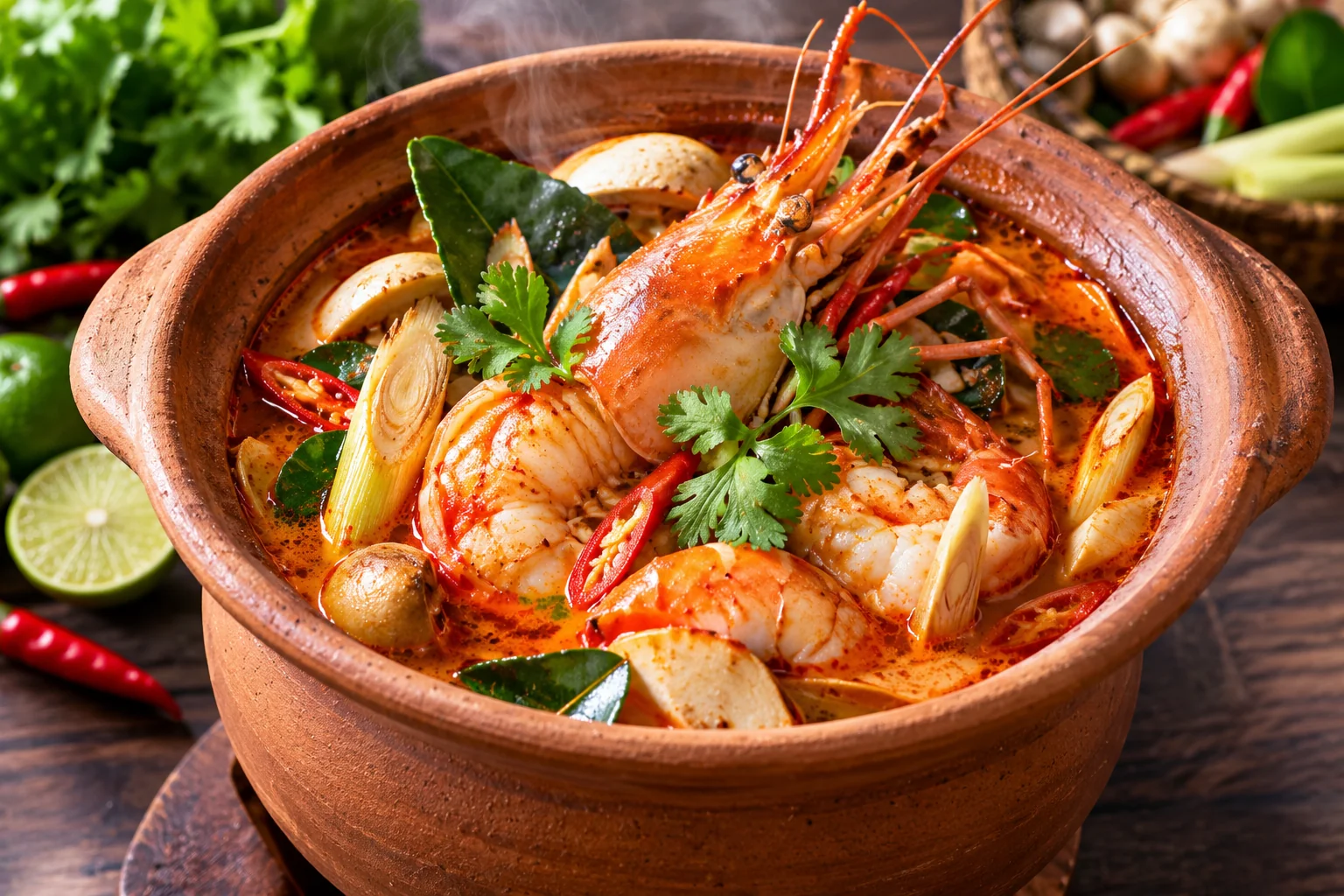
1. Tom Yum Goong (ต้มยำกุ้ง): The Fiery Sour Shrimp Symphony
Ranked consistently among the world's greatest soups, Tom Yum Goong is the aromatic crown jewel of Central Thailand. Fresh freshwater river prawns (Goong Mae Nam) are simmered in a roaring broth infused with three indispensable herbal pillars: freshly sliced galangal root (Kha), crushed lemongrass stalks (Takhrai), and hand-torn kaffir lime leaves (Bai Makrut). There are two distinct traditional varieties:
- Tom Yum Nam Sai (ต้มยำน้ำใส): The original crystal-clear broth. Sharp, citrusy, and blazing hot, seasoned purely with crushed bird's eye chilies, fish sauce, and freshly hand-squeezed lime juice.
- Tom Yum Nam Khon (ต้มยำน้ำข้น): The modern creamy variation. Enhanced with roasted sweet chili jam (Nam Prik Phao), prawn head tomalley oil, and a splash of evaporated milk, yielding a velvety, sunset-orange broth that coats the palate in luxurious richness.
2. Pad Kra Pao (ผัดกะเพรา): The True National Soul Dish
While Pad Thai holds the international spotlight, Pad Kra Pao is what Thai locals eat when they crave genuine comfort. Minced pork (Moo Sab), diced chicken, or tender beef is wok-tossed over screaming inferno heat with garlic, fiery chilies, dark sweet soy sauce, and massive handfuls of peppery Holy Basil (Bai Kra Pao)—a distinct herbal variety entirely different from sweet Italian or Thai sweet basil (Bai Horapha). The non-negotiable crowning glory is a crispy-edged, runny-yolked fried duck egg (Khai Dao) served over hot jasmine rice, accompanied by a small bowl of chili-infused fish sauce (Prik Nam Pla).
3. Massaman Curry (แกงมัสมั่น): The King of World Curries
Repeatedly voted the world's most delicious food by CNN Travel, Massaman Curry reflects centuries of maritime trade and intercultural diplomacy. Originating in the 17th-century Ayutthaya royal court through Persian-Muslim merchants, Massaman departs from traditional coconut curries by incorporating whole dry-roasted Indian and Middle Eastern spices: cinnamon bark, green and black cardamom pods, whole cloves, star anise, cumin, and nutmeg. Slow-braised beef shank or bone-in chicken thighs melt alongside tender waxy potatoes and roasted peanuts in a velvety coconut cream sauce seasoned with tamarind pulp and palm sugar.
4. Gaeng Keow Wan (แกงเขียวหวาน): Aromatic Green Curry
Named for its vibrant emerald color, Thai Green Curry derives its hue and herbal punch from green bird's eye chilies pounded by hand with fresh cilantro roots, lemongrass, shallots, garlic, and wild white galangal. Simmered in rich first-press coconut cream (Hua Khati), the curry is loaded with sliced chicken breast or tender beef, marble-sized Thai round eggplants (Makhuea Pro), and tiny bitter pea eggplants (Makhuea Phuang) that burst with juice between the teeth, finished with fresh sweet basil leaves.
5. Som Tum (ส้มตำ): The Mortar-Pounded Papaya Wonder
Originating in the agricultural heartland of Isaan (Northeastern Thailand), Som Tum is pounded to order in a heavy clay mortar with a wooden pestle. Shredded green, unripe papaya is bruised alongside garlic cloves, fresh chilies, yardlong beans, halved cherry tomatoes, roasted peanuts, dried baby shrimp, and tart lime wedges:
- Som Tum Thai: Mild, sweet-and-sour, packed with peanuts and palm sugar—the ideal introduction for international travelers.
- Som Tum Pu Pla Ra (ส้มตำปูปลาร้า): The authentic Isaan powerhouse featuring salted black rice-field crabs and pungent fermented fish sauce (Pla Ra), delivering an earthy, funk-laden, umami explosion.
The Street-Tested Heroes: Everyday Local Staples
Beyond the menus of formal restaurants, Bangkok's culinary greatness lives on the sidewalks, cooked by master vendors who have perfected a single specialized recipe over four decades of dedication.
6. Kuay Teow Reua (ก๋วยเตี๋ยวเรือ): Rich Boat Noodles
Originally paddled through Bangkok's canal networks by boat vendors, Boat Noodles feature an intensely aromatic, spiced broth simmered for hours with beef bones, cinnamon, star anise, pickled tofu, and a splash of seasoned cow or pig blood that adds an unmistakable velvety thickness and rich mineral depth. Served in small, affordable bowls (15–30 THB) with chewy rice noodles, braised beef brisket, bouncy pork meatballs, morning glory greens, and a shower of crispy pork cracklings (Kaep Moo), locals typically stack five to eight empty bowls per sitting.
7. Khao Kha Moo (ข้าวขาหมู): Melt-in-the-Mouth Braised Pork Leg
Whole pork trotters and hocks are slow-simmered in colossal bubbling woks of Chinese five-spice broth containing star anise, cinnamon quills, coriander seeds, and dark soy sauce until the meat slips effortlessly from the bone and the gelatinous skin dissolves like silk. Sliced warm over fragrant jasmine rice, it is accompanied by stewed braised duck eggs, braised mustard greens (Phak Kat Dong), raw garlic cloves, fresh bird's eye chilies, and a fiery yellow vinegar-garlic chili sauce that cuts cleanly through the pork fat.
8. Khao Man Gai (ข้าวมันไก่): Fragrant Hainanese-Style Chicken Rice
Adapted from early Hainanese immigrants, Thai chicken rice is an exercise in deceptive simplicity. Plump whole chickens are gently poached until succulent and juicy. The resulting rich chicken broth is used to cook jasmine rice infused with rendering chicken fat, sliced ginger, and garlic cloves. The soul of Thai Khao Man Gai lies in its signature dipping sauce: a savory, spicy concoction of fermented soybean paste (Taochiao), grated raw ginger, minced garlic, red bird's eye chilies, lime juice, and dark sweet soy sauce, served with a steaming bowl of clear winter melon soup.
9. Moo Ping & Gai Yang with Sticky Rice (หมูปิ้ง & ไก่ย่าง)
From early dawn along commuter BTS stations, the sweet, smoky aroma of Moo Ping signals breakfast. Thin pork shoulder slices marinated in coconut milk, garlic, white peppercorns, coriander roots, and palm sugar are threaded onto bamboo skewers and grilled over charcoal embers until caramelized and glistening. Paired with steaming hot sticky rice (Khao Niew) kept warm in woven bamboo kratip baskets and spicy toasted rice-powder dipping sauce (Nam Jim Jaew), it represents street dining in its purest form.
Regional Gastronomy: The Four Culinary Kingdoms of Thailand
Thailand's geography spans over 1,600 kilometers from misty northern mountain ranges to southern tropical islands, dividing into four distinctive regional culinary realms:
1. Central Thailand (ภาคกลาง)
The fertile Chao Phraya river basin. Characterized by royal court heritage, coconut milk curries (Green, Red, Massaman), sweet-savory balance, jasmine rice, and elaborate fruit carving.
2. Northern Thailand (Lanna / ภาคเหนือ)
Cool highland climate. Sticky rice staple, non-coconut herbal broths, charred chili dips (Nam Prik Num), mild Burmese curries (Gaeng Hang Lay), aromatic herbal pork sausages (Sai Oua), and Khao Soi noodles.
3. Northeastern Thailand (Isaan / ภาคอีสาน)
Semi-arid plateau. Fiery bird's eye chilies, sour lime juice, fermented fish seasoning (Pla Ra), sticky rice, roasted rice powder (Khao Khua), refreshing meat salads (Larb, Nam Tok), and Som Tum.
4. Southern Thailand (ภาคใต้)
Tropical coastal peninsula. Intense fiery heat, fresh turmeric root, rich shrimp paste (Kapi), sour curries (Gaeng Som), dry-spiced meats (Khua Kling), and fermented fish entrail curry (Gaeng Tai Pla).
The Thai Table Condiment Set: Seasoning Like a Local
In authentic Thai dining culture, the cook presents a foundational dish, but the diner holds ultimate authority to customize it to their personal palate. On every local dining table sits the iconic four-compartment condiment caddy (Pruang Prung):
- Prik Nam Pla (พริกน้ำปลา): Fresh sliced red and green bird's eye chilies submerged in premium fish sauce with lime juice and raw garlic cloves—the universal savory umami booster.
- Nam Som Prik Dong (น้ำส้มพริกดอง): Sliced hot chilies pickled in distilled vinegar, used to cut richness in noodle soups and pork dishes.
- Prik Bon (พริกป่น): Sun-dried chilies roasted in a dry wok and ground into fragrant, fiery chili flakes.
- Nam Tan (น้ำตาล): Pure white sugar or palm sugar granules, added sparingly by locals to balance excessive sourness or aggressive chili burn.
Frequently Asked Questions (FAQ) About Savory Thai Food
คำถามที่พบบ่อยและข้อมูลสำคัญที่คุณควรรู้ รวบรวมโดยผู้เชี่ยวชาญท้องถิ่น
Q1 What is considered the single most famous savory Thai dish?
Globally, Pad Thai and Tom Yum Goong are the most famous dishes. However, within Thailand, Pad Kra Pao (holy basil stir-fry with minced meat and a crispy fried egg) is universally regarded as the true national comfort dish eaten daily by locals.
Q2 How do I order food in Thailand if I cannot eat spicy food?
Use these essential Thai ordering phrases:
- "Mai Pet" (ไม่เผ็ด): Not spicy at all (zero chilies added).
- "Pet Noi" (เผ็ดน้อย): Mildly spicy (one small chili).
- "Mai Sai Prik" (ไม่ใส่พริก): Do not put any chilies.
- Dishes naturally non-spicy include Khao Man Gai (chicken rice), Khao Kha Moo (braised pork leg), Kuay Teow noodle soups, and Pad See Ew (stir-fried wide noodles).
Q3 What is the difference between Tom Yum Goong Nam Sai and Nam Khon?
Nam Sai is the traditional clear, sharp broth made purely from lemongrass, galangal, kaffir lime leaves, lime juice, and chilies. Nam Khon is the creamy modern variation enriched with roasted chili jam (Nam Prik Phao), prawn fat oil, and evaporated milk, creating a richer, sunset-orange soup.
Q4 Is street food in Bangkok safe to eat for tourists?
Yes. Bangkok street food is consumed daily by millions of residents. Follow these proven food safety rules: choose busy stalls with high turnover where food is cooked fresh to order over high heat, verify clean running water, and drink bottled or purified water.
Q5 What gives Thai food its unique aromatic fragrance?
The distinctive aroma comes from the holy trinity of Thai aromatics: fresh galangal root (Kha), lemongrass stalks (Takhrai), and kaffir lime leaves (Bai Makrut), alongside Thai garlic, shallots, coriander roots, and aromatic Thai Holy Basil.
Q6 Why is fish sauce (Nam Pla) so essential in Thai cooking?
Fish sauce is the fundamental source of saltiness and umami in Thai cuisine. Made from fermented anchovies and sea salt aged for 12 to 18 months, it provides deep, savory complexity that plain table salt cannot replicate.
Q7 What is the difference between Holy Basil and Thai Sweet Basil?
Holy Basil (Bai Kra Pao): Peppery, clove-scented, serrated leaves used exclusively in spicy stir-fries like Pad Kra Pao. Thai Sweet Basil (Bai Horapha): Sweet, aniseed-scented, purple-stemmed leaves used in Green Curry, Red Curry, and herbal noodle soups.
Q8 What is Som Tum made from, and is it always spicy?
Som Tum is made from shredded unripened green papaya hand-pounded in a mortar with garlic, chilies, tomatoes, lime juice, and peanuts. It is naturally spicy, but you can request Som Tum Thai pet noi (mild) or mai sai prik (no chilies).
Q9 How much does a bowl of authentic street food cost in Bangkok?
A standard plate or bowl of street food (Pad Kra Pao, Boat Noodles, Khao Man Gai) typically costs between 50 and 80 THB ($1.40 – $2.30 USD). Premium seafood dishes or famous Michelin-recommended stalls may range from 120 to 300 THB.
Q10 What should I do if a dish is too spicy for my mouth?
Do not drink plain cold water, which merely spreads chili oils (capsaicin). Instead, drink whole milk, eat sweet condensed milk treats, take spoonfuls of plain steamed jasmine rice, or order a sweet iced Thai milk tea (Cha Yen) whose dairy fats dissolve capsaicin instantly.
Q11 What are Boat Noodles (Kuay Teow Reua)?
Boat Noodles are small, rich bowls of rice noodle soup originally sold from vendor boats along Bangkok's canals. The dark, deeply spiced broth is simmered with beef or pork bones, star anise, cinnamon, and seasoned blood for extra richness and silky texture.
Q12 Are vegetarian options easily available for savory Thai food?
Yes. Look for the yellow triangular flag with red Chinese character "Jay" (เจ), indicating strict vegetarian and vegan food free from meat, seafood, fish sauce, garlic, and onions. You can also request dishes to be cooked "A-harn Jay" or "Mang-sa-wi-rat".



.webp&w=1920&q=75)
.webp&w=1920&q=75)